
The Real Turquoise Guide: How to Know What You're Buying

We have been selling turquoise from the same corner of Old Town Scottsdale since 1979, and almost every day someone walks in with a piece they bought somewhere else and asks the same quiet question: "Is this real?"
Sometimes it is. Often it isn't. And the difference is rarely something you can see from across a counter — it lives in the stone, in the mine it came from, in how it was treated, and in who made the piece.
This guide is everything we would tell you if you sat down with us for half an hour: how to tell genuine turquoise from imitations, what mine names like Sleeping Beauty and Kingman actually mean, what "stabilized" really is (told honestly, because most of the industry mumbles through that part), why a signature on the back of a cuff matters, and how to keep turquoise beautiful for the next forty years. No pressure and no jargon — just what four decades behind the counter teaches you.
First, the stone itself. Turquoise is a hydrated copper and aluminum phosphate that forms in dry, copper-rich ground — which is exactly why the American Southwest, and Arizona in particular, produces so much of it. Copper gives turquoise its blue; iron shifts it toward green. It is December's birthstone, it has been treasured since ancient Egypt, and it is the stone that Navajo, Zuni, and Hopi silversmiths built an art form around.
The Mines: What Sleeping Beauty, Kingman & the Others Mean
Turquoise is one of the few gems sold by the name of the ground it came out of, the way wine is sold by vineyard. Each mine's geology — its particular mix of copper, iron, and host rock — gives its stone a recognizable face. When you browse our turquoise necklaces or cases in the showroom, these are the names on the tags and what they mean.
Sleeping Beauty — the sky-blue classic

From the mountains near Globe, Arizona — named for a ridgeline said to look like a sleeping woman — Sleeping Beauty is the most famous turquoise in the world for one reason: pure, even, sky blue with little or no matrix at all. Robin's-egg blue, clean as a summer sky. That uniform color is exactly what gem graders prize most in turquoise, and it made Sleeping Beauty the standard that everything else gets measured against. The mine stopped producing turquoise in 2012 to focus on copper, which means the supply is finite: what exists now is all there will ever be, and prices have climbed steadily since. Its clean blue pairs beautifully with 14K gold, which is why you'll find it all through our gold and turquoise collection.
Kingman — Arizona blue with black webbing

In the hills of the Mineral Park district outside Kingman, Arizona, people have dug turquoise for a very long time — stone hammers have been found in the ancient workings, left by Native miners centuries before Arizona was a state. Commercial mining took over in the 1880s, and Kingman remains one of the last American mines still producing today. Kingman's signature is a bright, high blue crossed with black or dark webbed matrix — bolder and more dramatic than Sleeping Beauty's clean sky, with some stones flashing silvery glints through the web. If you picture a classic Navajo cuff, you are probably picturing Kingman blue; you'll find plenty of it among our turquoise bracelets.
Royston — two colors in one stone
From a family-worked mining district near Tonopah, Nevada, dug since the early 1900s, Royston is the stone for people who love green as much as blue. Its trademark is a two-tone drift — deep green flowing into clear sky blue within the same stone — wrapped in a warm brown-to-golden matrix. No two Royston stones match, which is exactly the point: each one reads like a small landscape. Set in sterling, it feels older and earthier than the pure blues, and it has become one of the most requested stones in our showroom.
Morenci — the collector's stone
Morenci turquoise came out of the enormous copper mine of the same name in southeastern Arizona: a rich blue famously flecked with iron pyrite — fool's gold — that polishes to a silvery shine inside the stone. Turquoise recovery there ended decades ago; the mine produces only copper now. That makes genuine Morenci a collector's stone, and when a piece comes through our doors it tends not to stay long. If you see one in the case, that is the day to decide.
White Buffalo — the striking exception
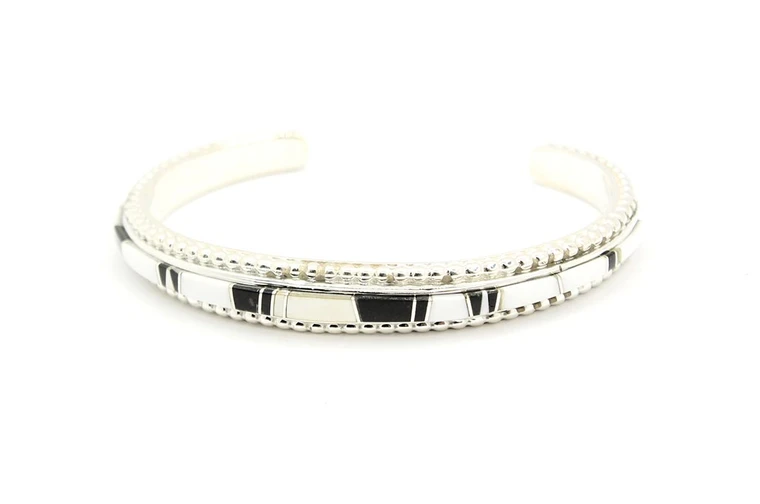
Here is where we tell you the truth the tag usually skips: White Buffalo, the dramatic white-and-black stone from a family turquoise mine near Tonopah, Nevada, is technically not turquoise at all. Turquoise gets its color from copper, and White Buffalo has none — gemologists classify it as a related white host stone (usually identified as magnesite or dolomite). The trade calls it "White Buffalo turquoise" because it comes from turquoise country and is cut and set exactly like turquoise, but we would rather you buy it for what it is: a rare, striking stone from a single place on earth, gorgeous in sterling silver. Its black-on-white drama has made our White Buffalo pieces some of the most asked-about jewelry in the store.
Other names you'll meet in our cases
Turquoise country is bigger than five mines. In the showroom you'll also spot Carico Lake, a Nevada stone famous for its clear spring green; Golden Hills, a soft pale blue laced with caramel matrix; Sonoran turquoise from Mexico's copper country; creamy pale-blue Dry Creek; and boulder turquoise, cut with ribbons of the brown host rock left proudly in the stone. Ask about any tag you don't recognize — telling these stories is the best part of the job.
Stabilized vs. Natural: The Honest Version
This is the part of the turquoise business that most sellers whisper past, so let's be plain about it.
Only a small fraction of the turquoise that comes out of any mine is hard enough to cut and polish exactly as it left the ground. That top grade is natural turquoise: nothing added, nothing changed. It is the most valuable form of the stone, it is collectible, and over years of wear it can slowly deepen in color as it picks up the oils of your skin — a living patina many collectors love.
Most of what any mine produces is softer and chalkier. Stabilized turquoise is that same genuine stone, pressure-treated with a clear resin that hardens it and brings up the color it would show when wet. Nothing about a stabilized stone is fake — it came out of the same ground; it has simply been made durable enough for a ring you wear washing your hands. Stabilization is the honest, decades-old standard for everyday turquoise jewelry, and without it, most people could never afford a genuine Kingman piece.
The only sin is silence. Stabilized turquoise sold as stabilized, at a stabilized price, is a good honest buy — often the right buy, especially for rings and bracelets that lead a rough life on your hands. Stabilized sold as natural, at a natural price, is a swindle. And dyed howlite sold as turquoise of any kind is simply a fake. When you shop with us, the tag and our staff will tell you which you are holding — ask us anything.
Hallmarks: What a Signature Tells You (and What It Doesn't)
Turn over a handmade piece from our cases and you will find a "Sterling" (or "925") mark, and often a second one: the artist's hallmark — initials, a name, or a small pictorial stamp that is the silversmith's signature. When it is there, it is a lovely touch of provenance: a hallmark can trace a piece to a particular Navajo, Zuni, or Hopi artist, sometimes to a family with generations at the bench.
But here is a truth many sellers skip: plenty of authentic handmade Native American pieces are not signed at all. Older and estate pieces, strands of beads, and beautiful work by artists who simply never took up a stamp — being unsigned does not make a piece one bit less genuine. What protects you is federal law (the Indian Arts and Crafts Act), which makes it illegal to sell jewelry as Native American–made unless it truly is — and a seller who knows their artists and stands behind every piece.
Some of our artists take it further. Ghostown, who rebuilds classic pocketknives with Sleeping Beauty turquoise inlay, dates and serial-numbers every knife so that no two are alike. And even unsigned work carries its maker's mark in another sense: Navajo pearls — those buttery hand-rolled sterling beads — take a smith hours of cutting, doming, soldering, and buffing per strand, and your fingers can find the faint hand-made facets that machine beads never have.
The handmade pieces in our cases come with natural stones and a story — we can tell you who made each one, signed or not. If a seller anywhere can't answer "who made this?", that answer is also information.
Caring for Turquoise
Turquoise is a stone you can wear for a lifetime — people hand cuffs down for generations — but it is a gentle stone: softer than quartz, slightly porous, and happiest with a few simple habits.
- Put it on last. Perfume, hairspray, lotion, and sunscreen can dull or discolor turquoise over time. Dress first, jewelry last.
- Keep it out of water and chemicals. Take turquoise off before swimming (chlorine is its enemy), dishes, gardening, and cleaning. Even skin oils slowly change natural stone — charming as patina, but you want it to happen slowly.
- Clean it gently. A soft cloth after wearing is usually all it needs. For real cleaning, use lukewarm water, a drop of mild soap, and a soft cloth or very soft brush, then dry completely. Never use ultrasonic or steam cleaners on turquoise — the gem labs are emphatic about this — and skip chemical dips entirely.
- Avoid heat and long sun. High heat can discolor the stone and damage its surface. Don't leave turquoise on a dashboard or a sunny windowsill.
- Store it kindly. Turquoise sits at 5–6 on the hardness scale, softer than most other gems. Keep it in its own pouch or compartment so harder stones and metal edges can't scratch it.
Silver tarnish, by the way, is normal and fixable — a silver polishing cloth brings sterling back. Just keep polishing compounds off the stone itself. And if a stone ever loosens or a cuff needs adjusting, bring it by; caring for these pieces is part of what we do.
Come See It in Person

Photographs flatten turquoise. In person, the stone has depth — light gets into it, the matrix reads like a map, and no two pieces sit on the wrist the same way. That is why, after everything in this guide, our best advice is the simplest: come hold the real thing.
We are Silver Star Jewelry, a family store in Old Town Scottsdale, in business since 1979. Everything handmade in our cases is made with natural stones by Navajo, Zuni, and Hopi silversmiths whose work we have carried for decades, and we will happily tell you the stone, the mine, and the maker of anything that catches your eye. Walk our showroom from anywhere first with our 3D virtual tour, browse our necklaces, bracelets, and rings online with free US shipping on orders over $99, or call us at (480) 949-1101 with a question about a stone you already own.
Bring in the piece you have always wondered about. We will take a look, tell you the truth, and either way, you will leave knowing exactly what you have. That is how it has worked here since 1979.